The Technical | Camera Equipment
Large Format Camera
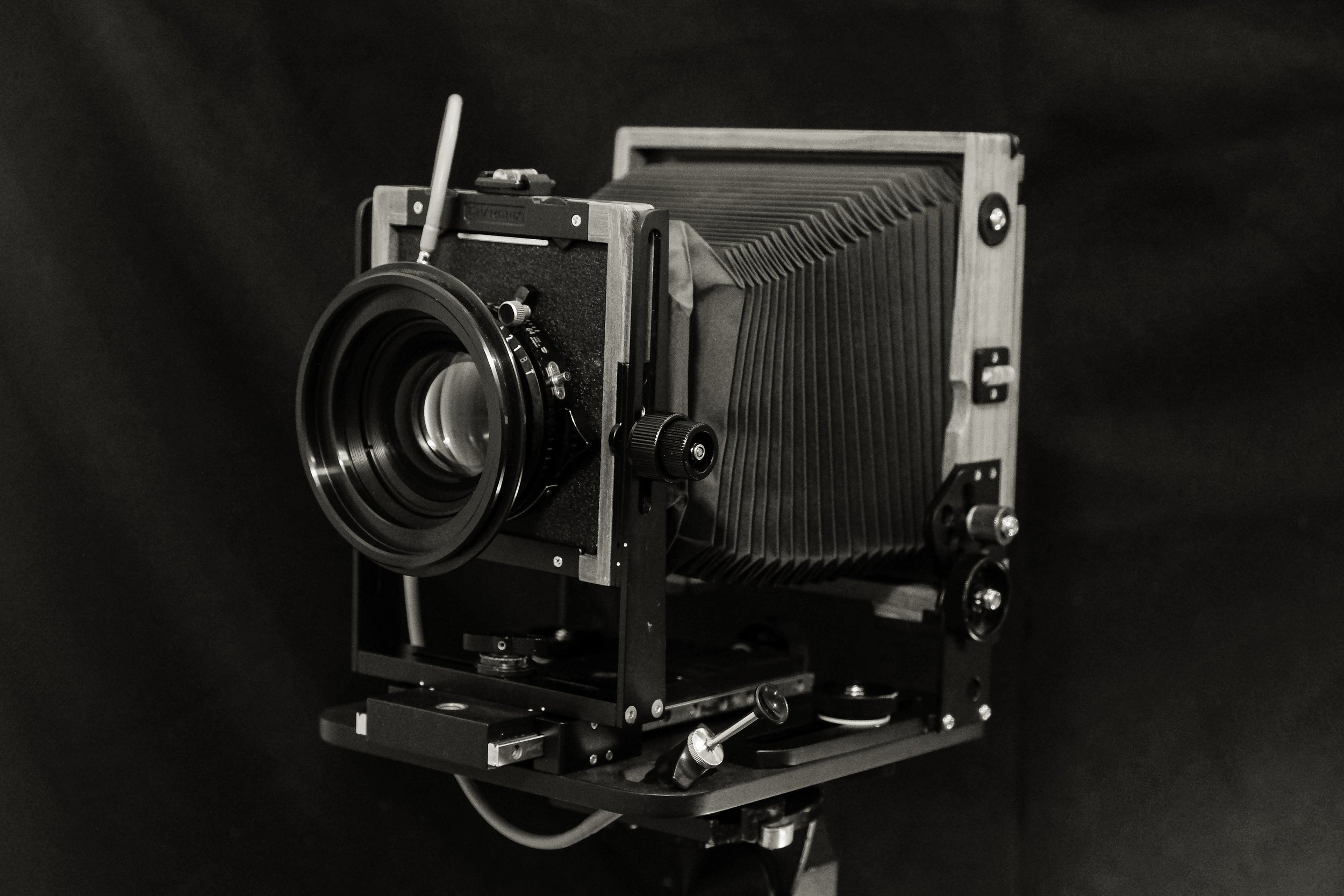
Chamonix 45f-2
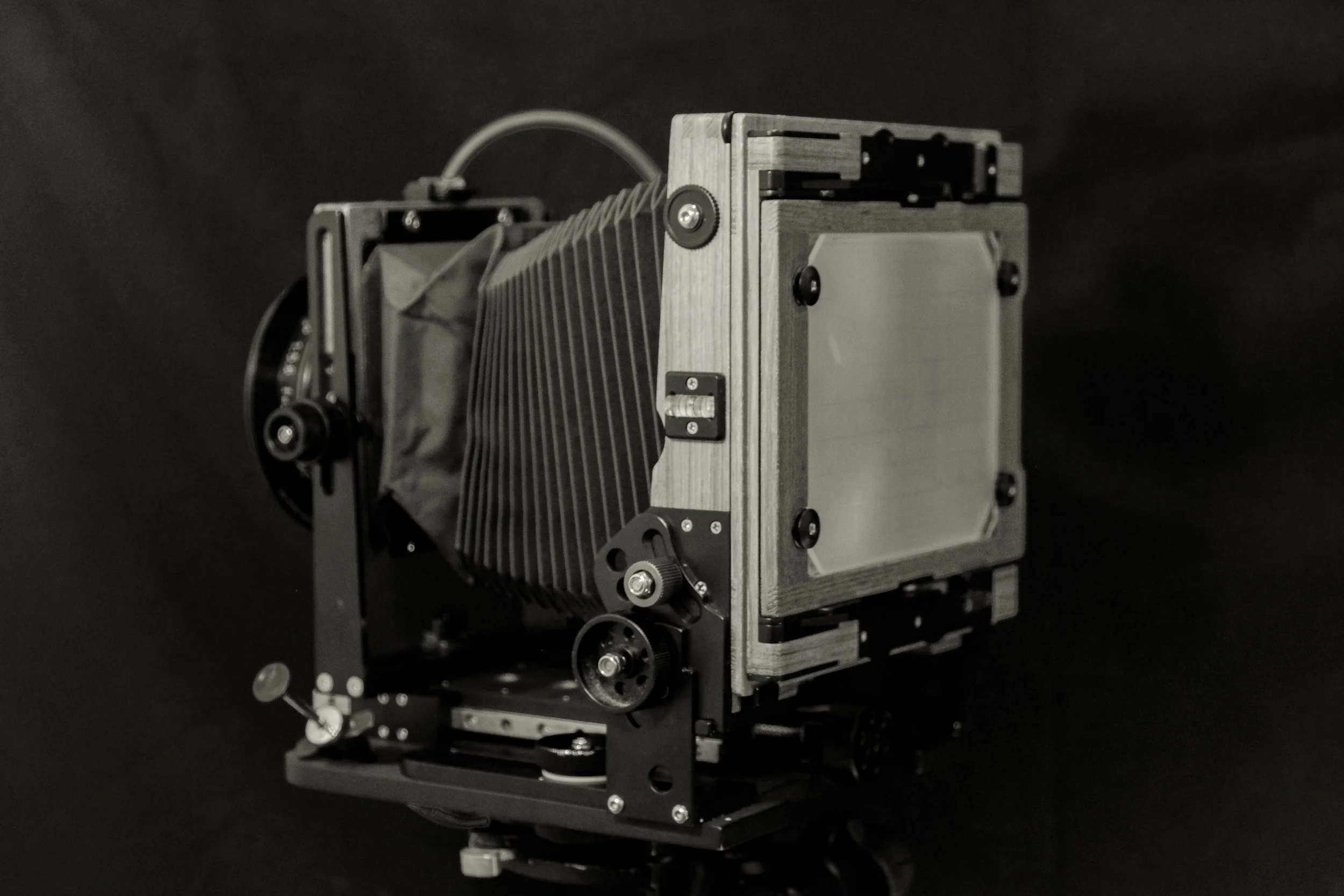
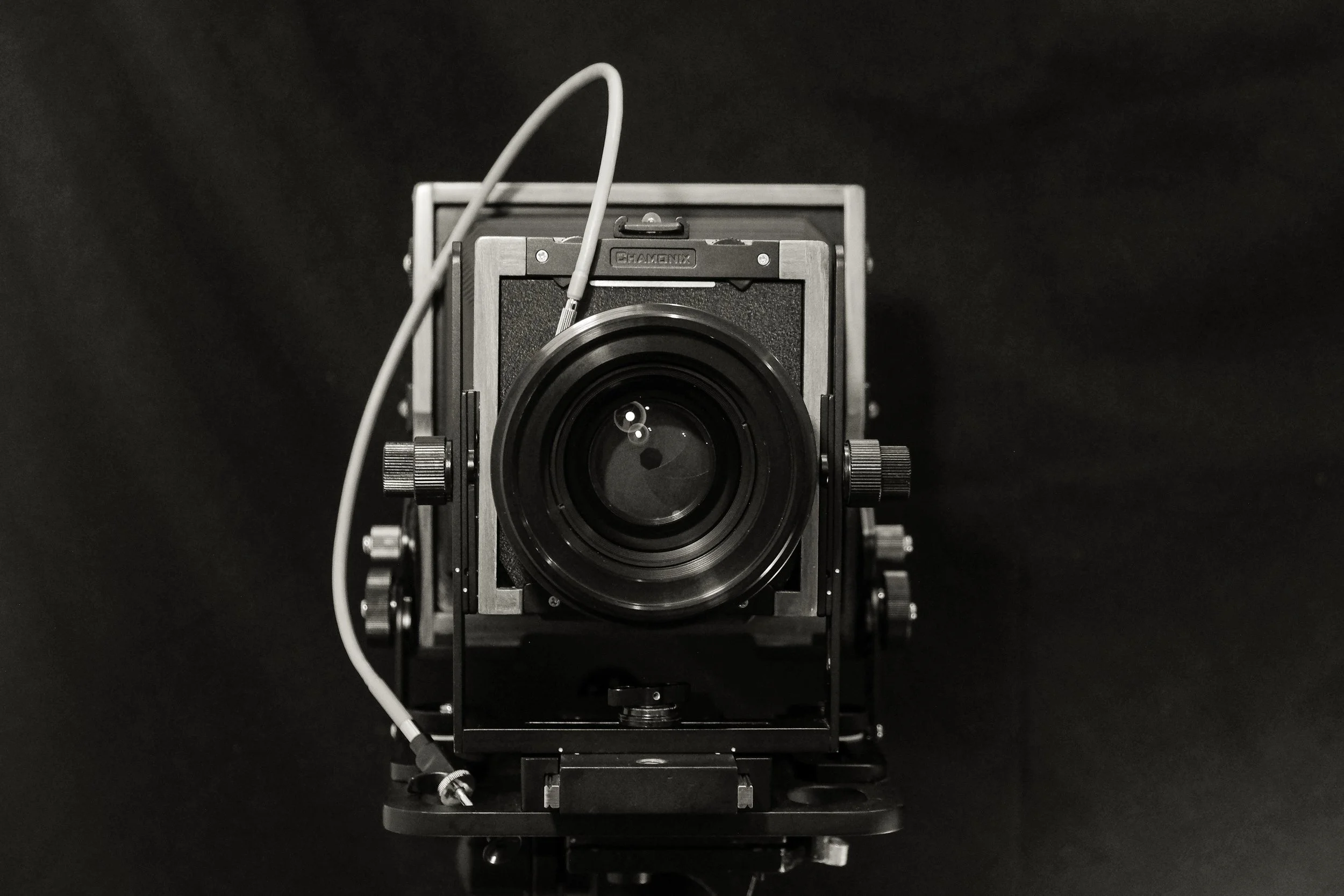
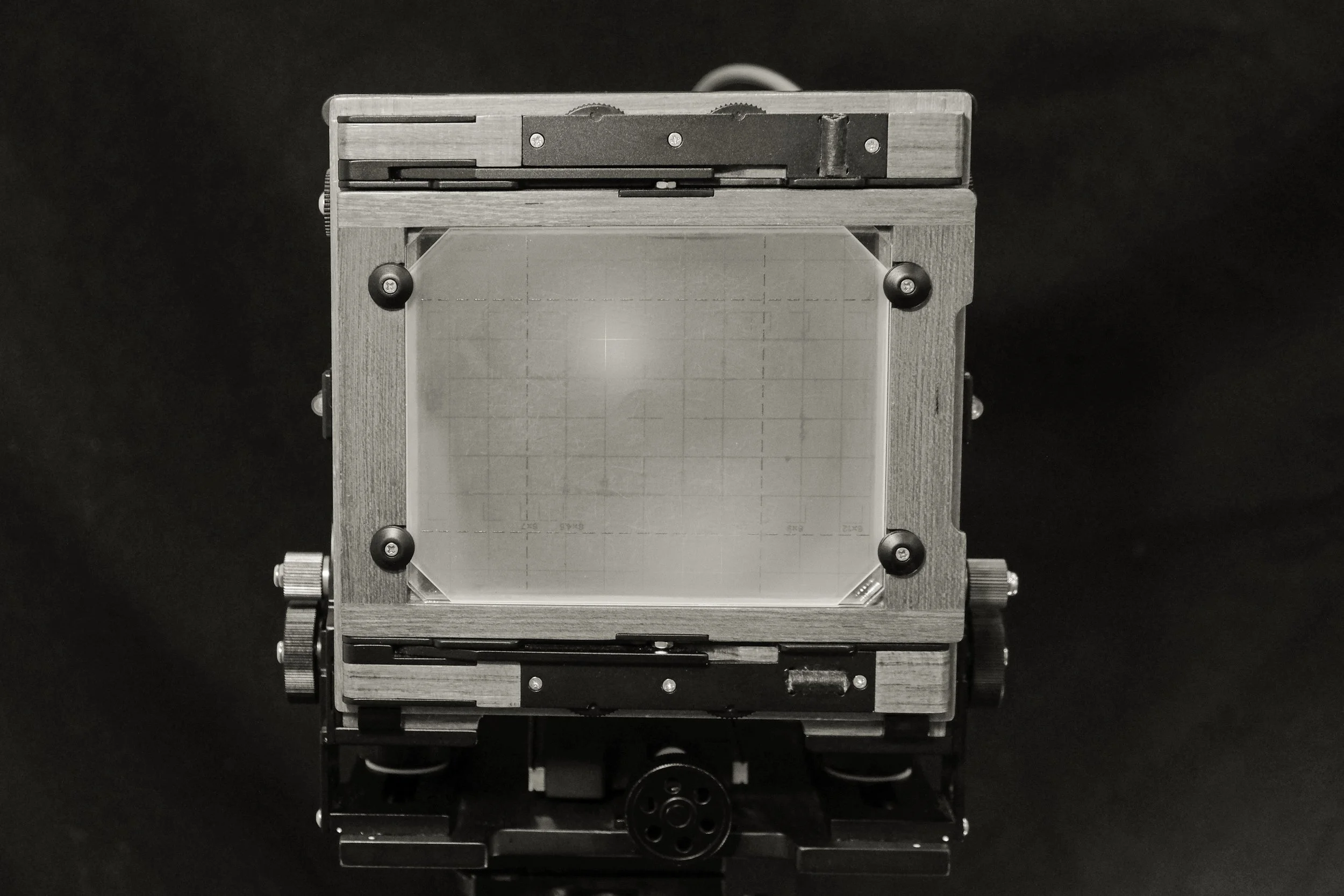
The majority of the images displayed in the Galleries have been made with a 4x5 Large Format Field Camera, a Chamonix 45f-2. Large format photography can be traced back to the 1840s, the beginning days of the medium itself. Field cameras, often referred to interchangeably as view cameras, were traditionally made of wood, leather, and brass. These cameras were meant to be taken out into the world to make imagery, rather than stay housed in a photography studio. Field cameras are generally mounted on sturdy tripods and require the photographer to build the camera setup at the chosen location. As these instruments require several parts (the camera body, lenses, filters, film holders, and tripod, among other items), large format photography was often made difficult by the weight and size of the equipment needed to capture imagery.
Modern designs based on the same fundamental camera concepts dreamt up in the 1840s have finely tuned the craftsmanship, technical performance, and overall weight of the field camera today making it possible to, with effort and planning, embark on backcountry camping trips with a large format kit, food and bear canister on your back. The process used today remains the same as the beginning: a lens is attached to a wooden box with extending bellows and a piece of light sensitive material is placed on the back plane of the wooden box. The lens is opened by a cable release for the given exposure time, and then the film is developed in photographic chemicals. It is an entirely manual, entirely analog, and entirely serene process.
The film negatives are each 4” by 5” in dimensions, hence the 4x5 title. The size of the negatives remains one of the primary artistic appeals of large format photography — the larger the negatives, the greater the detail, the larger the print. This is one of the main reasons I am drawn to the format. The Chamonix 45f-2 is light weight, precise, beautifully crafted, and more than capable of withstanding elemental conditions natural to a landscape photographer. Given that the camera itself is, in simple terms, only a wooden box, one still needs to purchase the various lenses, lens boards, filters, filter adapters, film holders, and other photography accessories to accompany the camera. While there remains some lenses and cameras that can be purchased new, most items in the large format photography are repurchased from other photographers or camera outfits selling materials online. This can prove difficult at times, but I do take pride in knowing that my camera kit comes from places around the world including South Africa, Germany, Japan, China, Switzerland, England and the United States.
Large Format Lenses
75mm Schneider Super Angulon f/5.6 MC Lens: This is my widest angled lens. The 75mm focal length is equivalent to a 24mm focal length in traditional 35mm measurements. This lens is incredibly sharp given the breadth of the imagery captured. I purchased this lens before a several week long camping trip in the Redwoods as it provides oneself the ability to capture grandiose scenes in tight quarters. While I continue to use it in dense forest conditions like the Redwoods or on Mount Tam, I have found the focal length to be too wide for open landscape scenes. In those circumstances, I prefer the 90mm or 150mm lenses instead. This is the widest angle lens I can fit on my Chamonix 45f-2 before having to use recessed lens boards.
90mm Rodenstock f/6.8 Grandagon-N Lens: This has become my most used lens. Equivalent to a 35mm focal length, the compositional frames this lens provides is most suitable for my landscape images. I often find myself backed up next to another tree in the woods, with a cliff to my side, or emerged in marshes, rivers or creeks. In tight quarters, I want to ensure that I can capture the expansiveness, the depth, and intricacies of the scene and attempt to transport the viewer to the scene itself. I have found that the 90mm lens captures scenes most comparable to how I experienced them. This gives these images an inviting feel, as if one was standing there alongside the camera.
150mm Nikon Nikkor-W f/5.6 WR Lens: The classic, standard 50mm frame equivalent, this lens has been superb and versatile. I use this lens mostly when desiring a classic look or to tighten up some frames in a more dense environment like the forest. I love this lens because it also doubles as my macro lens. By extending the bellows of the Chamonix beyond the focal length of the lens (e.g., extending the bellows to 300mm on a 150mm lens), the image will become magnified 1x1. This is how most of the closeup images of flowers, ferns and other still life are made. The sharpness and detail when one magnifies is breathtaking. This is one of the best all around focal lengths to have in a large format kit.
210mm Rodenstock f/5.6 Apo-Sironar-N Lens: This lens is equivalent to a 60-65mm focal length, providing the ability to capture unique compositions. The lens shortens the distance between myself and the composition when my feet and the land will not allow. It is helpful when standing across lakes, rivers, canyons, valleys and tree groves and attempting to shoot tighter frames. I have found that I use this lens most when taking nature portraitures, i.e. portraits of a single trees, rock spirits, or cacti. This is also one of my favorite focal lengths for abstract imagery and framing geometric lines within the landscapes.
300mm Nikon f/9 Nikkor-M: Equivalent to a 100mm focal length, this is my longest focal length. Most telephoto shooters have lenses that range from 100mm - 400mm focal length. The difficulty in shooting in focal lengths over the 100mm equivalent in large format photography is that the bellows have to extend that far in order to properly focus the image. Extending ones camera beyond the 100mm equivalent lens requires bellow extensions. All of this can still be accomplished, but it makes focal lengths over 300mm more involved to work with and less ideal for the backpacking photographer. This lens is the sharpest and most precise lens I have worked with.

Next Large Format Lens: The next large format lens will be a telephoto lens. It will be nice to add a little more length to my current setup. At a 100mm focal length equivalent to a 35mm camera, my longest lens is not all that long. A longer lens will help give distance to my compositions and will compact them as well. With this, however, I will have to use bellow extensions. A longer lens will allow for capturing more detailed images of more distanced land, which promotes seeing the world in more abstract images, layers and textures; more compressed images.
Medium Format Camera
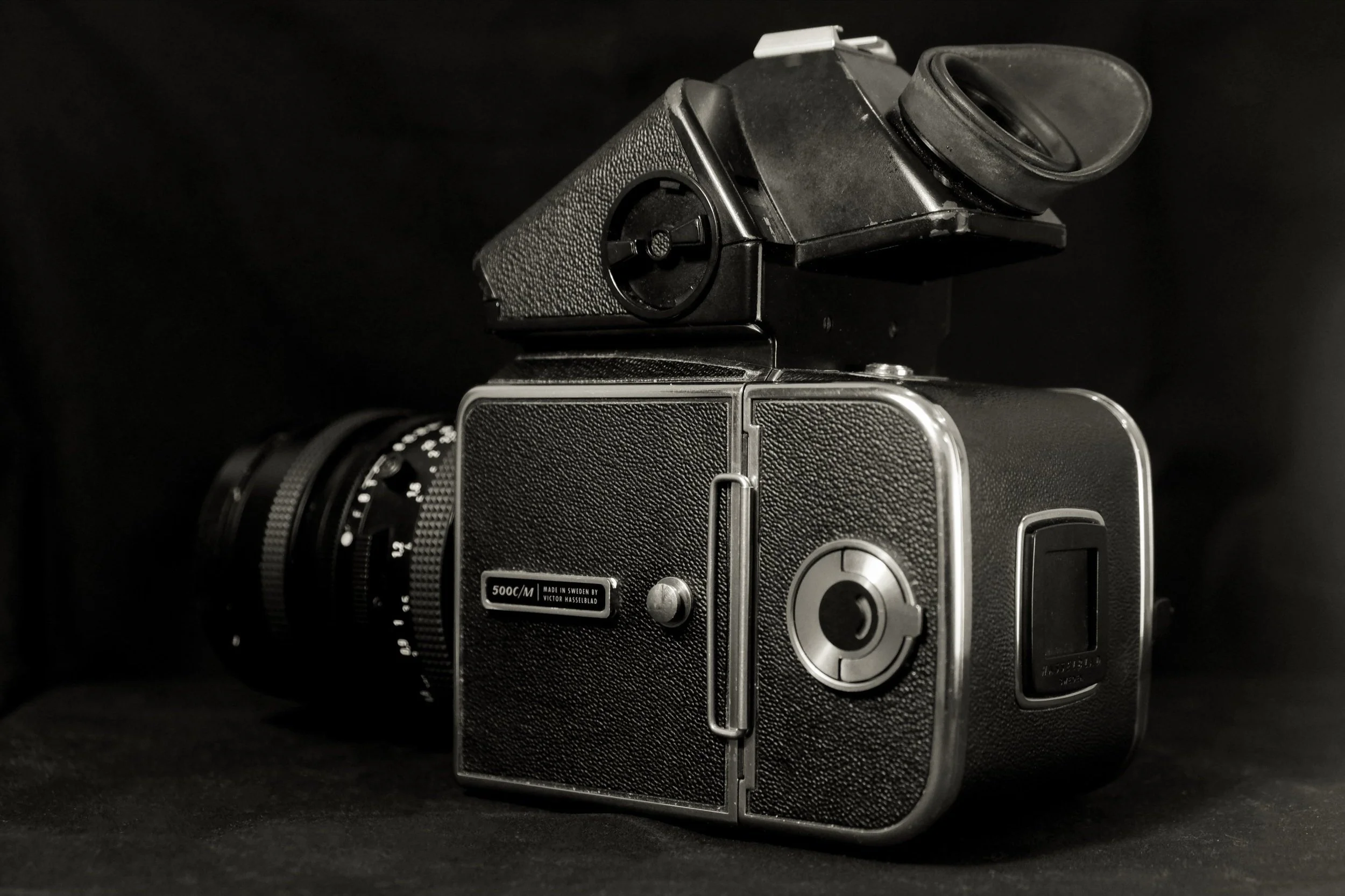
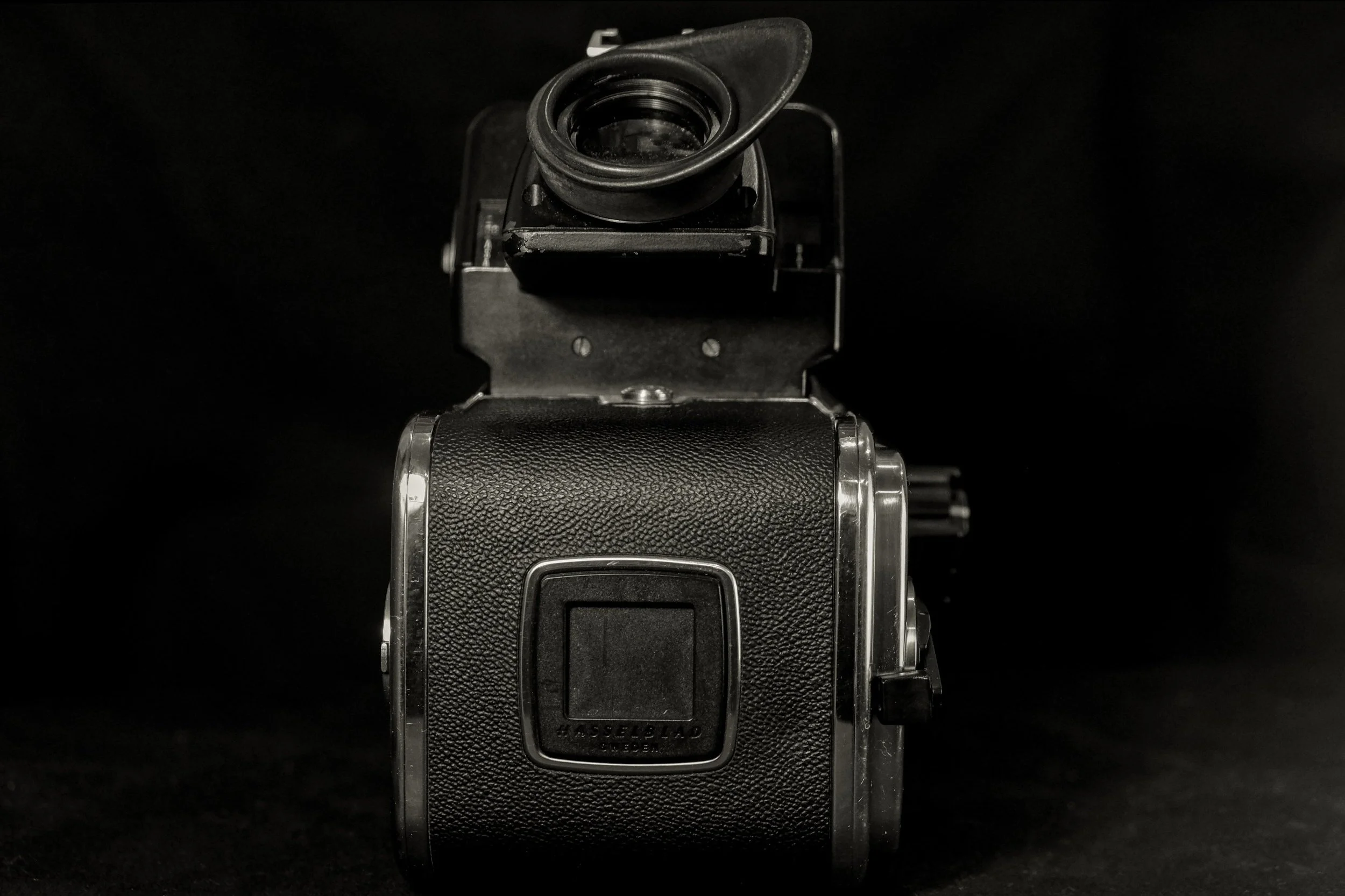
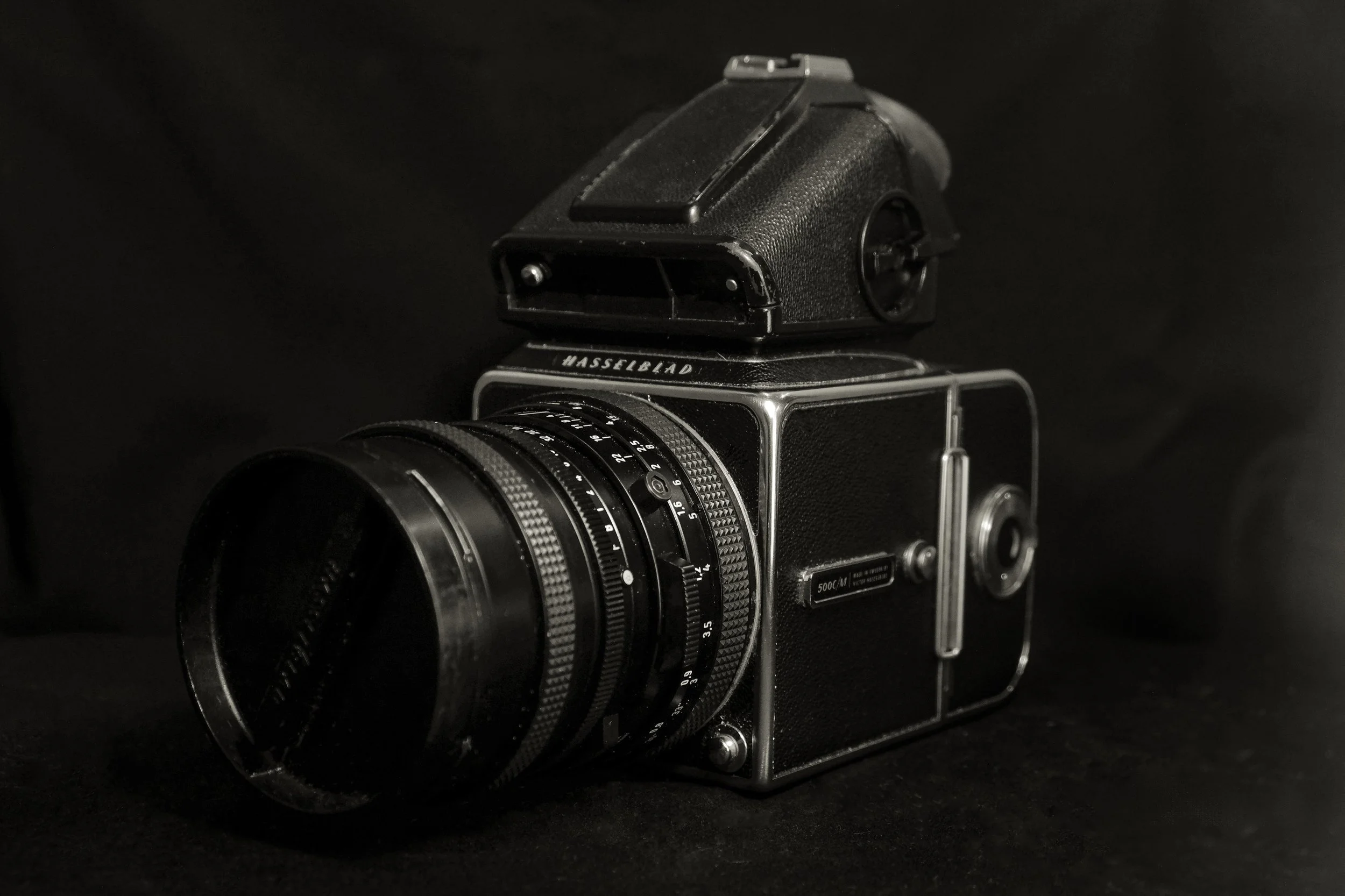
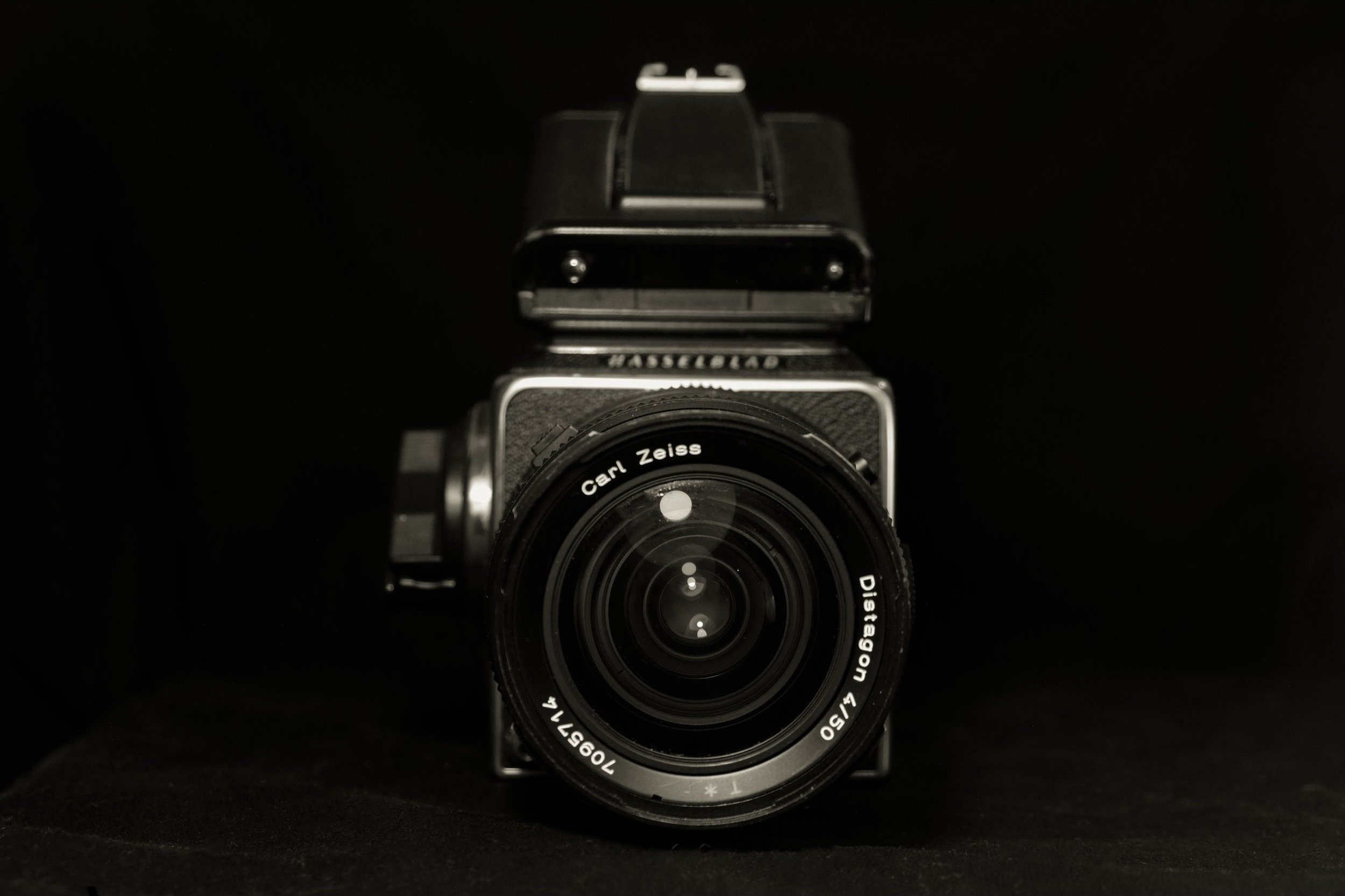
Hasselblad 500C/M
The images in the Galleries that are of the square format have been captured with my Hasselblad 500C/M. This is one of the most legendary film cameras ever built. The camera was used to document iconic moments in photography from images of Yosemite by Ansel Adams to those captured by astronaut Walter Schirra from the moon in 1962. The Hasselblad 500 series began with the 500C launched in 1957. The Hasselblad 500C/M launched in 1970 and ran production until 1994.
Coming from a storied history, I was drawn to the Hasselblad 500cm for many of the same reasons as other photographers. The camera design is aesthetically unique and beautiful; the build, sturdy and sleek. The camera is a tangible experience — from the weight of the machine to the sounds of the film advancing or the shutter “whomp” — it is one that will not be forgotten. The camera is also fully modular. The camera back, which holds the film, the viewfinder, and the lenses are interchangeable parts. In essence, the Hasselblad can be transformed into anything the photographer can dream.
Perhaps the main appeal of the Hasselblad 500 series is the glass. Camera lenses are generally more important than the camera body they are mounted on. Get good glass, is one of the earliest pieces of photography advice I received. Well, there is no better glass in medium format than the German-made Carl Zeiss lenses. These lenses were groundbreaking when they launched and remain some of the most highly sought after glassware in the photography industry.
The Hasselblad 500 series produce negatives in the 6x6 cm square format. The camera allows for 12 shots on 120 film. It is a unique format that takes some time getting used to, but once one does there are no shortages of beautiful black and white squares surrounding you.
Lenses for Hasselblad 500cm
Hasselblad Distagon T 50mm F/4 FLE CF
Hasselblad Zeiss Planar 80mm f/2.8 CF
Hasselblad Carl Zeiss Makro-Planar 120mm f/4 T* CF Lens
Photographic Accessories
Sekonic L-758 Light Meter
Filter Adapter Rings & Lee Filter Holder
Fidelity Elite 4x5 Film Holders
Patagonia Lightweight Fannypack, Field Notes, Viewfinder Tool, 12% Gray Card
Minerva Stopwatch
Peak Antistigmat Loupe 4x
Lee Filter System

2 Stop GND Soft; 2 Stop GND Medium
3 Stop GND Soft; 3 Stop GND Hard; 4 Stop GND Soft
Red, Orange, Yellow, Green Filters; Warming Filter 81B
3-Stop ND Filter; 10-Stop ND Filter
Lee Polarizer
Filters
Film Stocks & Developer
Film Stocks
Kodak TMax 100: My film of choice is Kodak Professional TMax 100. TMax 100 is a low-speed panchromatic black and white negative film. It is known for its extremely fine grain structure as well as its high sharpness and resolving power. The film uses a T-Grain emulsion, which resembles a patterned, tabular form. This allows for the film to perform well when being enlarged or scanned. TMax 100 also has a wide exposure latitude, meaning that it handles high contrast scenes well. The film has a dynamic range that spans around +/- 4 stops. This is crucial when dealing with the high contrast lighting situations that I often find myself in.
Developer
Kodak Xtol: I develop my images in a home darkroom using a replenished system of Kodak Xtol. The combination of Kodak TMax 100 and Kodak Xtol (Replenished) makes for the most pleasing and consistent negatives. Kodak Xtol is a solvent developer known for its fine grain and high sharpness. It is a perfect match for the fine grain and high sharpness of TMax 100. It is also a highly versatile developer, suitable for all kinds of black and white films.
One of the main reasons I settled on Kodak Xtol is that you can create a replenished system. This means I use one seasoned solution to develop my negatives and then replenish a small amount of the seasoned solution with fresh solution after each round of development. In theory, the seasoned solution can persist in perpetuity and all that needs to be replaced is the fresh stock solution. This results in less waste as I only discard of a small fraction of spent developer rather than the entire solution if one were to use them on a one-shot basis.
The replenished system also allows for one to create stability in their development process. After the developer has been seasoned, the photographer can hone in on precise development times, agitation methods, and other techniques to achieve certain aesthetic desires. Time-tested notes become a photographer’s best friend.
It is invaluable to be able to develop my own images at home. This allows me complete control over the entire negative making process. Decisions on camera settings in the field inform development decisions made in the darkroom. Each of these, and all of them, can significantly impact an image. I can now individually treat each sheet of film I expose. I highly encourage any film photographer to develop their own film at home.
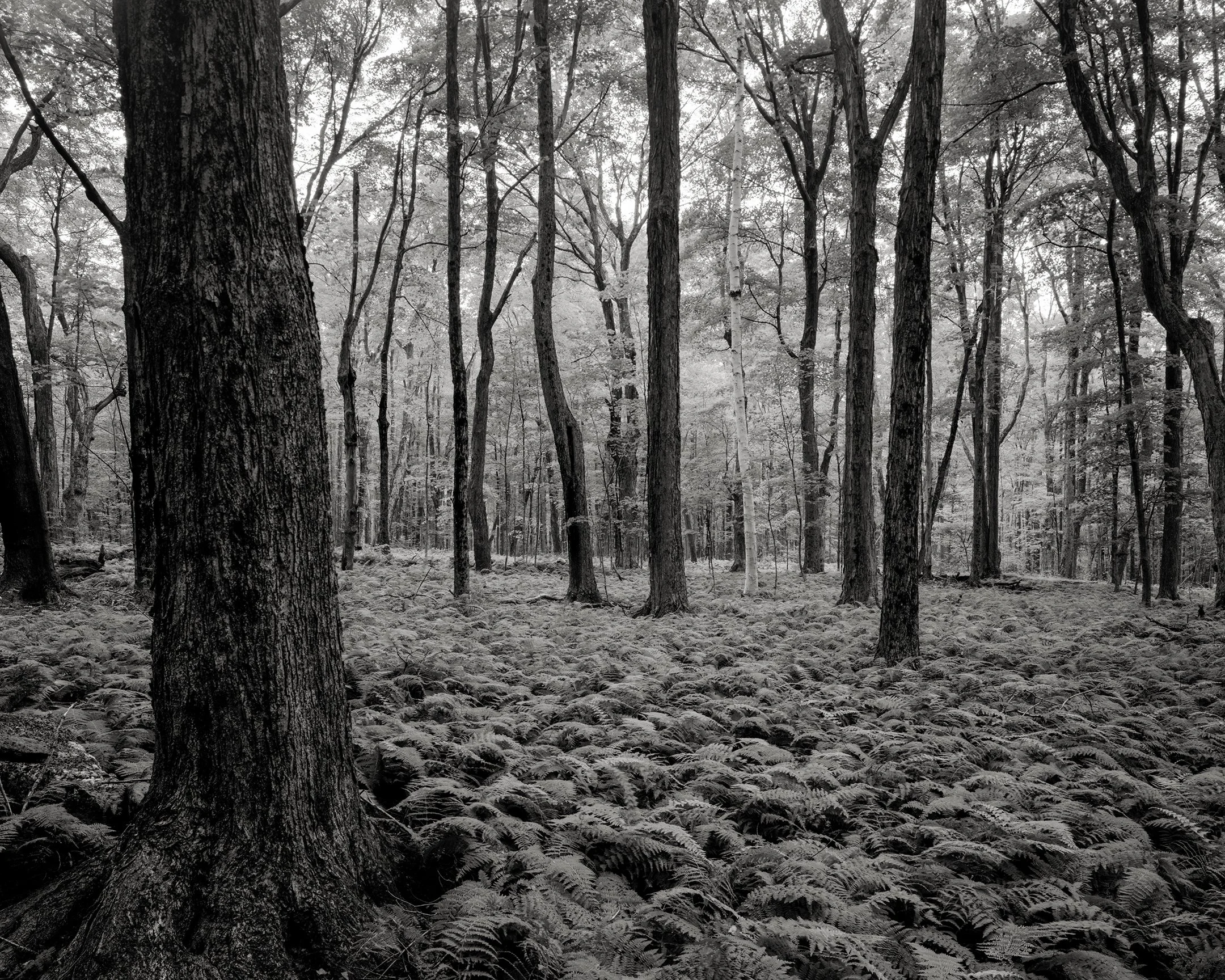
Rooted
Land of the Massaco | Simsbury, CT